

The original blueprint
World Giving Project: A Blueprint for Collaborative Impact
TransparenC began with an idea originally called the World Giving Project. We believe transparency should include our own evolution, so the original mission document is reproduced here in its entirety, unedited.
Read this as history, not as current policy
This is the founding document of what became TransparenC — written in January 2016 under the name World Giving Project. It describes a specific business model from that time: a 30% Service Provider contribution, a 10% charity benchmark, an office-supply e-commerce plan, Holacracy as an organizational structure, and a "Passion Projects" giving program.
Not all of it survived into TransparenC. Where this document's specifics differ from how TransparenC actually operates today, treat the rest of this site — not this page — as current. We're publishing it unedited because transparency about where we came from is part of the same commitment we're asking of everyone else.
Contents
- 01Introduction
- 02Vision + Goals
- 03Past to Present
- 04The 3 Stages
- 05Organizational Structure — Holacracy
- 06Charity
- 07Alignment of Service Providers
- 08Room for Growth
- 09Sales Contribution
- 10Charity Contribution
- 11The Case for the Office Supply Market
- 12Who We Are
- 13Challenges
- 14Sales Initiatives
- 15Concept App Development
- 16Exhibit A
- 17References
Forward to the Business Plan
Written in January 2016, the following paper is meant to be read as an experiment with the ultimate goal to help inspire the next revolution of capitalism. With the rapid advancement of Artificial Intelligence and transformative changes in employment and daily life, reimagining capitalism itself has never been more crucial. This document is not a solution but a North Star, guiding a community to actively participate in the growth and evolution of this vision, using the power of storytelling.
Guidance for Readers
As you navigate through this plan, we invite you to engage with an open mind. The structure and strategies detailed herein serve as the starting canvas; however, the true essence of WGP lies in its evolutionary nature. It is the collective insight, creativity and decision-making of involved individuals that will shape the destiny of the project.
Your Role in the Experiment
WGP is not just a concept; it's a living experiment. As a potential member of this initiative, you hold the power to influence how this project grows. From the services we offer to the communities we impact, every aspect is a variable that you can help define. This plan is not only to be read but to be acted upon, molded, and expanded by you – the architects of a new paradigm of business.
A For-Profit Adventure
Make no mistake, while our mission is transformative and community-focused, WGP is a for-profit venture. We believe that financial sustainability is key to creating lasting impact and driving the revolutionary changes we envision in the developed system.
Introduction
This is a project of giving and receiving. In order for it to work, it must be authentic. We are naming the project World Giving Project after our work with Merchant Giving Project. Our goals are meant to remove any walls and any inside-the-box thinking from the very beginning. In order to accomplish this, the goals are kept broad in their description and the individuals who become involved with the project will choose which direction their actions will go to contribute to such goals. Largely, the people of the project will decide how the veins of this organization will move and attach. To succeed in this, we have selected Holacracy as the organizational structure, which has a pre-designed system of accountability and assignments of roles based on the implementation of a Constitution and cloud-based software, committing and helping each person to be their own leader as much as possible. World Giving Project is a lead generation based sales model for signed WGP Service Providers.
Vision + Goals
World Giving Project is a collaboration of successful small businesses marketing their products and services under one marketing vehicle. The role of World Giving Project is to provide a lead generation service for the Service Providers who sign on with WGP. In this effort we will be building out tools designed to benefit increases in shopping of services on the site and funding for our Giving initiatives. Our goals can be brought into five brief descriptions, which will be a guiding point for the five pillars of the organization.
- Inspire other businesses to follow suit into Conscious Capitalism
- Give back to the local communities where we do business
- Fund our "Passion Projects" to make a difference as individuals
- Create wealth and desirable, purposeful gainful employment
- Change capitalism for the better
Past to Present
World Giving Project is an association of Merchant Giving Project. It began when WGP co-founder Dustin Palmer approached MGP owner Jeff Campion about doing his own version of give-back credit card processing to a specific target market in the window covering business. Dustin's background includes involvement in his family business that owns a collection of Hunter Douglas stores in Houston. He has been processing the family retail stores' credit card processing account since March of 2011 and has been receiving approximately $300 monthly and consistently with very little maintenance work in its entire duration from the single account. This has led to a prolonged interest in the credit card business. Dustin began thinking of a plan of action to get more Hunter Douglas processing accounts. After several attempts at locating the right processing platform for the business, Dustin heard of Jeff's give-back approach in June of 2014 and knew this was the direction.
Merchant Giving Project gives back 10% of the incoming residual to a charity of the customer's choice. The idea here is that business as a whole may experience a massive shift in these Conscious Capitalism approaches to their value proposition as a way of giving back to the community and to their own employees. According to the Ivey Business Journal, "Almost 70 percent [of millennials] say that giving back and being civically engaged are their highest priorities."
In late 2014, Dustin began working with Susan Leinen, a specialized marketer for design companies and for Hunter Douglas. After a very successful marketing assignment over the period of 6 months for the family business, Dustin approached Susan about working together on a new project involving credit card processing to Hunter Douglas retail stores. The initial approach was about offering a "product bundle" that we could take to Hunter Douglas retail stores to increase our chance of getting in the door with more offerings. The idea leant itself to the question of: How do we separate ourselves from the competition? Susan then added her service offering to our product bundle of Email Marketing services. Then Dustin introduced Susan to Jeff, and we decided after a meeting that we can all team up to approach these accounts, and that we should name the project something new since we were adding service offerings. That's when the name World Giving Project was suggested. In July 2015 we began the construction of a new website to display the offerings (www.WorldGivingProject.com). During this time, we noticed more people were interested in adding their products and services to the marketing effort especially when we explained the give-back approach, which we evolved into introducing "Passion Projects".
As we continue to gain momentum, we are adding more Service Providers and salespeople. Today, we have reached the point of moving more quickly and swiftly out of the infant stage into early childhood. Now full time on the project, Dustin's goal is to lead a tiered marketing approach to building out a lead generating engine.
The 3 Stages
In order to reach a growth spiral, we have separated our approach into three stages of focus. Each stage is meant to step-up our approach to the next level as we go and attract more site shoppers.
The First Step
The first step is to identify a critical mass of Service Providers quickly. This step is critical as it will turn on the engine of this vehicle. One at a time, we must bring on a new Service Provider to fill a new category of service offerings until we build out an entire catalog of possible offerings, at which point, we'll have identified the point of critical mass. As services are sold and often signed up and used by our own Service Providers, we'll have identified a source of organic growth. So as we move swiftly through this process, the point is to get as quickly into the second step as possible, like getting out of 1st gear and into 2nd in a sports car.
The Second Step
At this point we should be content with a proper and robust catalog of service offerings and a built-out list of WGP Service Providers. Our focus at this time should turn to becoming stewards for the businesses who use us. We must serve our Service Providers and customers alike. Designed to up our service capabilities, we'll introduce an E-Commerce platform to offer back office supplies with a significant portion donated to our Passion Projects. The annual size of this online market is $23 Billion, and currently is dominated by just two companies. More will be discussed about this market soon, but the belief is the market is prime for a shake-up. We will work with either of two organizations, SP Richards or Essendant, to supply the online catalog of products. To avoid carrying inventory, we'll use a drop ship method during this stage, and they'll package and ship to our customers.
To generate more funds for our charities and Passion Projects we'll offer 40% of our Operating Profit to fund our Passion Projects. This likely would never work at such high a percentage give-back ratio; however, we have specifically chosen to share from Operating Profit as this gives us leeway to still compete effectively against margin games and ever lowering prices. The second topic this addresses is that we can create more value for our Service Providers by putting in to their Profit Sharing contribution pool. This raises and makes our Value Proposition to Service Providers ever more attractive when moving swiftly through Stage 1. It also should inspire our Service Providers to sell our e-commerce as well intertwining us all as much as possible.
The Third Step
The third step is defined at the point in which the demand for Service Providers outpaces its critical mass. At this point, we'll have to address Service Provider organization structure. The use of Holacracy will play well for our success. As demand and data is gained, we'll be able to identify geographical measurements. To scale the Service Provider income source to its maximum potential, we'll take our built out catalog of service offerings generated in Step 1 and apply it to a geographical growth concept by city. One of the key questions we have been asked so far from our current Service Providers is what happens if a competitor of theirs wants to sign up with the World Giving Project? Undoubtedly, we hope this happens, as the first pillar is to inspire other businesses to follow suit into Conscious Capitalism. With anyone who wants to join, and exclude no one if possible we want to be able to affect anyone who draws their attention our way.
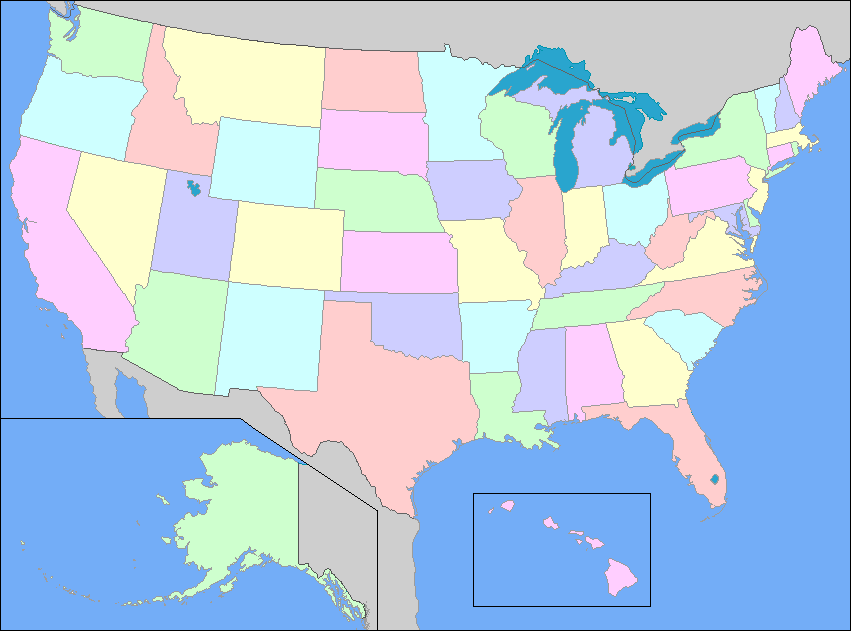
To increase order delivery satisfaction from our Service Providers to our customers, we will have to continually monitor customer feedback and ratings of the service. We'll already have a complete list of services, and we'll have to increase deliverability, so we should have the scale to evolve to a World Giving Project by city Service Provider list. Our second tenant is to give back to the local communities where we do business. We can elevate our effectiveness with our second tenant in mind by structuring the project by city. This will keep us more organized and suited for scale, and can pacify the concerns of the future Service Provider competition question by offering the solution. The solution here is that leads we generate can have a local impact by the customer opting to choose a local Service Provider. So effectively, we will aim to build out a complete catalog of Service Providers by city which makes room for competing providers.
This is a significant moment, because at this time, we can introduce Profit Sharing contribution pools to our Service Providers, one for each city we choose to have a presence. Again, this is approaching the idea of intertwining all of us as much as possible. As we build out a complete circle of service offerings in each city for growth, essentially aiming to duplicate each circle of service providers by city (Exhibit A), we can intertwine all the service providers together as a local World Giving Project team by incentivizing them through growth of their peers. The Holacracy method will keep accountability of roles filled so WGP can assure Service Provider satisfaction even more.
Organizational Structure — Holacracy
Holacracy is an organizational structure and method designed to adapt and evolve a company. It's a system that enforces working on the organization not just in the organization. The book Holacracy: The New Management System for a Rapidly Changing World, by the model's founder Brian J. Robertson says it best,
Holacracy helps an organization operate more like the way we actually ride a bicycle, using a dynamic steering paradigm. Dynamic steering means constant adjustment in light of real feedback, which makes for a more organic and emergent path. If you watch even the most skilled cyclist, you'll see a slight but constant weaving, as the rider constantly takes in sensory feedback about his present state and environment, and makes minor corrections to direction, speed, balance, and aerodynamics. Weaving arises because the rider maintains a dynamic equilibrium while moving forward, using rapid feedback to stay within the many constraints of the environment and equipment. Instead of wasting a lot of time and energy predicting exactly the "right" path in advance, he instead holds this purpose in mind, stays present in the moment, and finds the most natural way forward as he goes. That's not to say the rider doesn't have a plan or at least some sense of his likely route, just that he gains more control, not less, by surrendering to present reality continuously and trusting his capacity to sense and respond in the moment. Similarly, we have the opportunity to get more control in our organizations by more relentlessly facing reality and adapting continuously. Brian J. Robertson, Holacracy, p. 129
The system is built on a peer-to-peer network and its structure naturally evolves the company through its algorithmic process.
Modern evolutionary theory has identified four elements necessary for [Holacracy] to work its magic and unlock the power of evolutionary design:
- An encoding of a design
- A way to express that code
- A way to vary the code
- A means of testing a design's "fitness" and amplifying fit designs
With Holacracy, no single person designs the organization, and no single group sits down and designs the organization. Rather, an organization's design is an emergent result of an evolutionary algorithm. Brian J. Robertson, Holacracy, p. 140
Through Holacracy and the use of cloud based software, we can better keep track of roles, responsibilities, lead tracking, and order filling. To implement Holacracy in World Giving Project the correct way, it can cost between $10,000–60,000 and a better idea of cost would come into play after more discussions with HolacracyOne.
[Holacracy] structured the organization so that we have no employees. Rather, everyone is a partner in a legal partnership governed by the Holacracy constitution, with a voice in the organization's legal power structure through Holacracy's governance meetings. Brian J. Robertson, Holacracy, p. 190
Likely we would have as many people as we can send from the project to attend the Holacracy proper training forums. This program is referenced to be much like a sport, and the more it is practiced and played the greater levels of Holacracy's magic are experienced. The repeated phrase in the book is it comes down to a complete paradigm shift in the way we approach company governance including compensation. The quicker we can implement Holacracy into the project, the quicker we can experience the evolving growth effects which are brought by its method. The proper implementation benchmark as given to us by HolacracyOne is when we reach 12 organization members.
Charity
The second and third pillar of the World Giving Project is to give back to the local communities where we do business and fund our "Passion Projects" to make a difference as individuals. Just as the name suggests, we must truly be designed to give back in any capacity. As a project of giving, the intrinsic value far surpasses that of profit. The richness gained is greater than all purchases combined. When a single individual gives back authentically, they begin to experience gratitude on deep levels, never known previously but only when the act is committed, nurtured, and grown. Our fourth pillar is to create wealth and desirable, purposeful gainful employment. The beginning is wealth, both profit, but also intrinsic wealth gained only by truly being of servitude to others on a larger purpose other than the self. The next is desirable, purposeful gainful employment, and we'll aim to hit our mark as we begin to show our World Giving Project contributors their role is enlivened into the community through their participation with World Giving Project. We must authentically give in any capacity we are capable. Against conventional wisdom, we believe this will have an effect in multiples on return on investment far greater than a profit only focus.
One of the methods of attraction for our current Service Providers is the ability to add a Passion Project to the portfolio of contributed charities. Our Passion Projects are those in which we actually spend time volunteering. For example, Dustin works personally with Star of Hope, which works to eradicate homelessness one family at a time in Houston. Susan works with Shepherding the Nations where she travels to India to perform ministry work with the organization. These Passion Projects are ones in which we personally have a mission to grow, create some attachment, or help a problem that we want to solve. This is a part of the project where individuals can directly make a difference. And better yet, it is part of daily employment, just as a "TPS Report" might be at a standard organization. Millennials want to be a part of something civically oriented. One of the big issues we frequently hear is that millennial employees can't seem to stay in place at any one job. Perhaps we add that employment itself is changing and that it must, to adapt, incorporate personal growth into the very role. We believe this may solve the issue of millennials hopping around so much. Let's create desirable employment through this method and further our commitment to our core pillars this way.
We have WGP Contributors coming up with their own Passion Projects. For example, we are working with one who is designing a project to "Green" Detroit where he is from. It's going to increase even more now, purpose combined with profit, as millennials enforce new adoptions in business practices by demand. We believe we could experience a massive shift in how capitalism itself functions. The point is to stay ahead of it when it does, and perhaps even lead it to the extent we can offer influence.
Alignment of Service Providers
To capture our first pillar to inspire other businesses to follow suit into Conscious Capitalism, we won't actually change the brand name of our Service Providers. Instead, they are all already successful and proven brands, so that we can assure quality. Service Providers thus keep their names and their own brands, and by becoming a part of World Giving Project, we offer a solution to help grow their brand through a mutually shared commitment. This is very important for the project; it is a way for us to intertwine and weave us all together. Most Service Providers have already been working very hard on their own brand and, in fact, it's pivotal to their continued success. By suggesting they partner with World Giving Project, we are offering a whole new network of opportunities for that provider. The blueprint of this whole project is actually based on network effects. Network effects are those that increase exponentially in value as each new source is added. For example, the telephone: one telephone in the world is quite lacking value; however, add one, and value rises, add another and it more than doubles to the original user because of the network for what used to be uniquely formed scrap metal. It continues to rise as each one is added on an exponential basis. When applied to our model, it perhaps may even lend itself to a bandwagon effect, whereas each new Service Provider is brought onboard, the rate of adoption to the project and its new trends of working in collaboration increase at incrementally faster paces.
In short, Service Providers keep their own brand names, emails (if they want to), websites, etc; however, we'll have a rep agreement in place which states they publicly become a part of the World Giving Project by putting our active link logo on their website and in their email signatures. This way we can come up with easier programs when it comes to tracking residual lead business. While helping build their brand, the mutual commitment we share with the Service Provider is the contribution they commit from the new customers we bring to them, and ours to building a brand based model that will help small businesses compete in the marketplace, and design a system to help reach all five of the project's pillars.
Room for Growth
As we gain momentum, we can then have room to address more invested methods in increasing margins and profit. For example, the credit card business is a main attraction of ours, and one of the key points we'll make with our Service Providers is how to entice a credit card processing account with our customers. They'll be receiving a portion of this attractive revenue and again we are trying to get our customers also invested in relationship based approach with us rather than transactional. To accomplish this, we're going to aim for their credit card processing accounts and other services, which have more commitments like retail energy services. The selling process for retail energy and credit card processing are incredibly similar. We must earn their trust through our giving initiatives and transparency and accomplishment to obtain these accounts on a competitive scale.
For the credit card processing business, we can aim to become an established ISO in order to increase our margins if we can garner the proper demand. With this comes more responsibility, however, there will be more control over margins. Also, on the e-commerce front, we can move our distributor agreement from a drop ship method to an inventory method to increase our margins; again, only if the proper demand is in place would we move in this direction.
In addition, we would like to have sales representatives selling the project for customers to use as a source of business offerings. We are working on an app concept based on the shared community of shared selling.
Sales Contribution
Service Providers contribute to the World Giving Project in exchange for leads. Currently, we aim for 30% of each contract value. For example, if Copy Writing gets a lead turned to contract for $1,000 she will contribute $300 to the World Giving Project ecosystem. However, we have learned this is going to start to vary as we see more demand. We have feedback that 30% is high, but manageable, so we are working on finding a balanced medium. Each Service Provider is also keenly aware that their contributions are fuel and is necessary for the lead generating engine to function. In addition, the profit structures may vary by Service Provider, and the credit card processing may not earn money the same way as a Business Coach. With respect to different earning structures, we anticipate new models of contribution to be made as data is built.
Charity Contribution
This is going to be an ongoing investigation as to how much we can contribute to profit and how much to charity/Passion Projects. Merchant Giving Project does very well contributing 10% of monthly residuals to a charity of the customers' choice. Initially, we'll set a benchmark at a minimum of 10% of profit and leave it up to the Service Provider to decide if they want to increase that. We'll also continually balance this with how much of a financial impact our investment generates for our charities and Passion Projects. We'll help make a financial impact with the addition of 40% of operating profit from office supply e-commerce sales to our giving initiatives.
The Case for the Office Supply Market
There is no doubt the office supply market is large, and incredibly competitive. Approximately 70% of the market is dominated by Staples and Office Depot. The rest is serviced by niche players and smaller distributors who appeal to higher levels of specialty product and customer service compared to the price competition of the big box players. However, there is a fundamental shift occurring in the industry right now and it is ripe for a shakeup.
"Our customers are using less office supplies, they're shopping less often in our stores and more online and the focus on value has made the marketplace even more competitive," Staples CEO, 2013 earnings conference call
The way that customers are using less office supplies has to do with digitization and moving to tablets. Where the opportunity lies is in the cross-section of diminishing retail footprints and rising online sales. To compete with the increase in new online market retailers, Staples and Office Depot are adopting new ways to increase their attention on e-commerce. The market is shifting online as fewer customers are shopping in the stores.
Staples is responding by shrinking the square footage of their big box stores from 24,000 sf to 12,000 sf. The notable inclusion is that of an online kiosk presented at the stores in which shoppers can engage with staples.com. This is what they are calling the future of retail, that in which they use the incoming foot traffic from their stores to draw to online shopping in order to compete with everything from online presence to margin shrinking, and supply chain logistics. Online retailers have a natural advantage of operating margin over the retail stores in this category and have supply chain advantages.
According to Marketrealist, "[Office Depot] online strategy is targeted at consumers with a service and customer experience requirement. It believes these customers aren't as sensitive to the Every Day Low Prices, or EDLP, charged by its larger online competitors like Amazon (AMZN) or big-box retailers like Walmart (WMT) and Target (TGT). The company plans to compete with the big-box retailers by being a promotional price player. It plans to lower prices during certain periods." The most notable inclusion in this statement is that the second largest online competitor is focusing their attention on customer service and customer experience, and these customers are not as reactive to pricing variations.
An interesting fact of two of the top 10 U.S. online retailers in 2013 was that they were in office products, Staples, and Office Depot. Staples trailed only behind Amazon. There are all sorts of interesting stats here at play, from decreasing retail big box same store sales, to decrease in square footage at the stores, to increase in online demand and the change of instore experience to include online shopping in the stores.
This all points to one thing: this industry is a sleeping giant, and there is inner turmoil amongst its largest players on their future strategy implementation and its effectiveness. This is ripe to introduce a brand that encourages loyalty, awareness, giving back, attention to its customers as stewards of service, and complete solutions that can also include performing business services for them.
We are upping what is relevant in our offerings to include the ability to service our customers on shipping them their office supplies. World Giving Project sees this as incredibly relevant in addressing being stewards of service to our customers. We are increasing our capabilities of what we can serve customers under our umbrella initiative. We are full service, 360, this way, and can really provide a customer experience that generates positive emotions. We are again aiming for the bandwagon effect; the more we can serve, the quicker the adoption rates of loyal customers.
Who We Are
A short bio on the owners.
Challenges
-
#1
The revenue sharing needs immediate attention to firm up. 30% of contract value/sale should go into the World Giving Project ecosystem. The ecosystem is defined by the network in which WGP generates profit and shares the profit. We need a Service Provider rep agreement generated and in place immediately for mutual protection purposes. This is going to be important for our Service Providers and here is the challenge. For the network to function properly, we must discover the legal and protected way of revenue sharing. It is possible for each individual in a revenue sharing pool to be held accountable for the actions of a single Service Provider. This is going to interfere with any new Service Provider to sign up. The challenge is thus, to design a mutually protected revenue sharing Service Provider rep agreement.
-
#2
We must complete the setup of the proper foundation for the project. Everything from Trademarking to legal incorporation needs to be addressed. The specific challenge we have in incorporating the World Giving Project in Texas is we must obtain a notarized permission agreement by a current established non-profit outside of Dallas who has a similar name. The challenge is to obtain that notarized permission agreement so we can continue setup in its proper entirety.
-
#3
Step 3 introduces the addition of a revenue sharing pool for our WGP Service Providers. The quicker we can deliver revenue sharing capabilities, the better we can intertwine and weave the Service Providers into the WGP network. Purposely held off until Stage 3 for now, it could be likely that the percentages weighed into the contribution pool won't make much difference to the individual Service Provider until we reach critical mass. For this reason, to reach maximum potential of earning revenue with this model, we expand to a local effort in this stage and recreate a critical mass of Service Providers by city. This may help develop organization amongst chaos and help to solve the first challenge. In addition, it would create smaller circles of profit sharing pools in which we could duplicate for efficiency and effective purposes. The challenge here is to design the revenue sharing specifics now in order to calculate how much of their 30% contribution effort will be returned to them in revenue sharing forecasts. We will need to look at each service and devise the revenue sharing splits. This should be verified by a financial or accounting professional.
One question may be why we return money through revenue sharing practices if the Service Providers already agree to pay 30% of their contract value. It is because, again, it weaves us all together; this method induces cross selling and a method of organic growth. This leverages us all higher and quicker through marketing through our own peer network. And finally, many of the Service Providers are small business owners and revenue can greatly undulate each month. This method should give our Service Providers a steady and predictable income source and helps generate attraction to become a Service Provider. To complete this challenge, a verified commission structure must be solved. This is going to help prepare us for Step 3 and the concept app development.
If we solve all challenges here for this project, the likely result is a complete accounting system. The challenges are also all connected so that it would likely launch us out of 2nd gear and into 3rd.
Sales Initiatives
In the 1st step, most of the foundation will continue to be constructed. We are meant to tier and scale as we progress. The inertia, the initial sales effort, will take most of is form right away. It's important we get this boulder rolling.
We will start off with a series of hard push tactics. Email marketing, cold calling, door-to-door pop-ins, social media marketing services, anything that captures demand. Through email marketing, we will begin a series of reaching our target audience. Through this series we will build an organic list of customers. We will extend our outreach through follow up phone calls to the "opened list". We will aim to build and develop relationships and track with a CRM program. Through this time we will gain valuable feedback, thus as much to lead us to build out a complete sales model, which we'll go into shortly.
Following this initial push, we'll then be able to invest the returns into optimization programs. We'll immediately enhance our search engine optimization, and we'll use funds to build and garner a social media following. We'll then turn to scale up into varying media outlets for advertising. Finally, we'll make efforts to induce the Shoplet.com method for growing attraction. The related case study is found in References 12.
Through this process one thing will be a main center of focus: learning how to simplify and optimize the sales process. With so many different services, the role is still boiled down to one task – lead generation. If we take this concept and expand upon it, we can define what the future of the sales process for the project may be. Simply being, we can train marketers to train customers how to choose services on our site by webinars, videos, ways that we can visualize the process for the customer, and make it easier on the backend to supply qualified leads to our Service Providers. In place of selling each service individually, we'll focus on training customers on how to use the site and let the site functionality lead to proper lead disbursements.
Each Service Provider gets an allotted one page on the site to sell their services and with a Call To Action. We can help design the pages for the Service Provider or they can do it themselves. It is meant to display products and prices to the viewing customer. The site's functionality will have to evolve with the project as more Service Providers come onboard. At this moment, it acts as an interactive billboard for our Service Providers, and our site acts as the marketing vehicle, bringing shoppers and site viewers. We see this growing to becoming a more capable search tool as we evolve.
Concept App Development
The shared economy is growing from ride sharing services to home and business delivery. The concept is still in its infancy, but undoubtedly shaking industries awake. Shared selling is possible. Let's design an app around letting users with ownership contacts reap the rewards for their knowledge.
For example: Wouldn't it be neat if you were in a coffee shop, and happened to know the owner? You open an app that gives you shared access to a wide range of products and services. You ask your friend, "Which of these services do you use?" Together, you select a range of products and services. Through the app, you input simple ownership information, and a unique customer code pairs you up with that customer. From now on, anything that customer buys from our company WGP, that app user (you) earns a percentage of all the sales made.
The idea hits on a couple points; one is that it turns everyone into a potential sales person for our company. The second is that, in a way, the app user becomes a customer service representative liaison, without formally being in that role, for each new pairing contact. This could present another opportunity.
One of our main WGP goals is to inspire giving back. We can extend our outreach of businesses donating to charity, to have our shared selling economy users decide where their money should be donated. This may help inspire more people to take action in their communities.
The model can change as we build out the appropriate programs, but the idea is that we can make a difference in a new type of employment opportunity. Like having a car and turning it into a shared riding service generating money, we could inspire a new approach for those with either ownership contacts, or those willing to pound the pavement door to door getting new contacts and businesses to sign up. To make it attractive, we can make the app seem like a game of Monopoly, moving the user from one business to the next, and the users can either earn rewards points like on a credit card rewards points system, or earn direct cash, perhaps even compete against friends for fun. This all depends on if we can come up with a commission structure attractive enough to make this work. At this point, this is purely in concept mode; however, we believe it is an attainable concept and would be highly appealing particularly to millennials. We could make it competitive; for example, if a user hasn't talked to an account they signed up for a certain period of time, the contact becomes free game and someone else can earn the points or residuals if they become a better service representative. This is another opportunity for us to build more stewards of service for the project.
A "Hop In" Slack invite link appeared here in the original 2016 document. It is omitted from this reproduction because it no longer leads anywhere current.
Exhibit A
A visualization of the ring of critical mass. Step 1 reveals the method of filling each role individually to define the complete ring. Once the ring is defined, we can move into the next phase. The ring is important because it identifies a source of organic growth as WGP Service Providers tend to work with each other for business services.
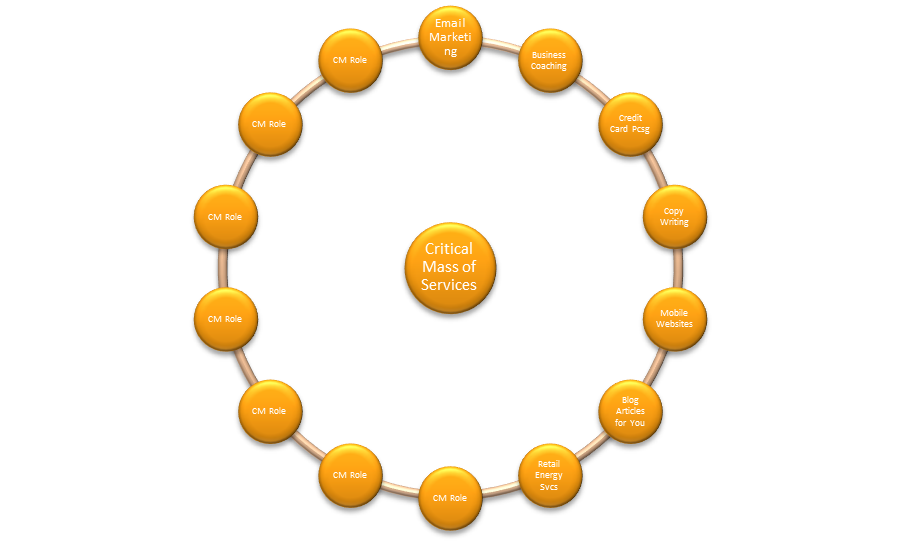
Exhibit A (Cont.)
Step 3 expands upon the ring of critical mass by city. For efficiency and simplicity purposes, we can aim to duplicate the ring after it has been completely defined by Step 1.
References
- Christakis, Nicholas A., and James H. Fowler. Connected: The Surprising Power of Our Social Networks and How They Shape Our Lives. New York: Little, Brown and Company, 2009. Print.
- Mackey, John, and Raj Sisodia. Conscious Capitalism: Liberating the Heroic Spirit of Business. Boston: Harvard Business School Publishing Corporation, 2013. Print.
- Csikszentmihalyi, Mihaly. Flow: The Psychology of Optimal Experience. New York: HarperCollins Publishers, 1990. E-Book.
- Robertson, Brian J. Holacracy: The New Management System for a Rapidly Changing World. New York: Henry Holt and Company, 2015. Print.
- Subramanian, Guhan. Negotiauctions: New Dealmaking Strategies for a Competitive Marketplace. New York: W. W. Norton and Company, 2010. Print.
- Chopra, Deepak. The Spontaneous Fulfillment of Desire: Harnessing the Infinite Power of Coincidence. New York: Three Rivers Press, 2003. Print.
- Tindell, Kip. Uncontainable: How Passion, Commitment, and Conscious Capitalism Built a Business Where Everyone Thrives. New York: Grand Central Publishing, 2014. Print.
- Thiel, Peter, and Blake Masters. Zero to One: Notes on Startups, or How to Build the Future. New York: Crown Business, 2014. Print.
- Gilbert, Jay. "The Millennials: A new generation of employees, a new set of engagement policies." Ivey Business Journal. Ivey Business School. October 2011. iveybusinessjournal.com
- Layne, Nathan, and Nandita Bose. "Bulk retailers are hurting business at office supply stores." Business Insider. Reuters. 5 Feb 2015. businessinsider.com
- "Office Supply Stores Industry Overview." Hoovers. hoovers.com
- Kirkpatrick, David. "B2B E-commerce: How an online retailer garnered 100% top-line growth in its affiliate program (plus 5 more marketing channels)." MarketingSherpa. 4 Jan 2012. marketingsherpa.com
- Biery, Mary Ellen. "Office-Supply Stores Seeing Profit Margins Erased." Forbes. 13 April 2014. forbes.com
- Soni, Phalguni. "Why Is Starboard Interested In Staples And Office Depot?" Market Realist. 23 Dec 2014. marketrealist.com
- "Staples launches in-store kiosks for endless aisle." Kiosk Marketplace. 20 June 2013. kioskmarketplace.com
- "Staples' Omnichannel Stores Showcase the Future of Retail." Staples. 20 June 2013. investor.staples.com
Where this led
This document became TransparenC.
The lead-generation model, the giving pillars, and the belief that a transaction should account for more than profit — those carried forward. The Service Provider revenue split, the office-supply e-commerce plan, and Holacracy did not. TransparenC is what we built after testing this blueprint against reality.